
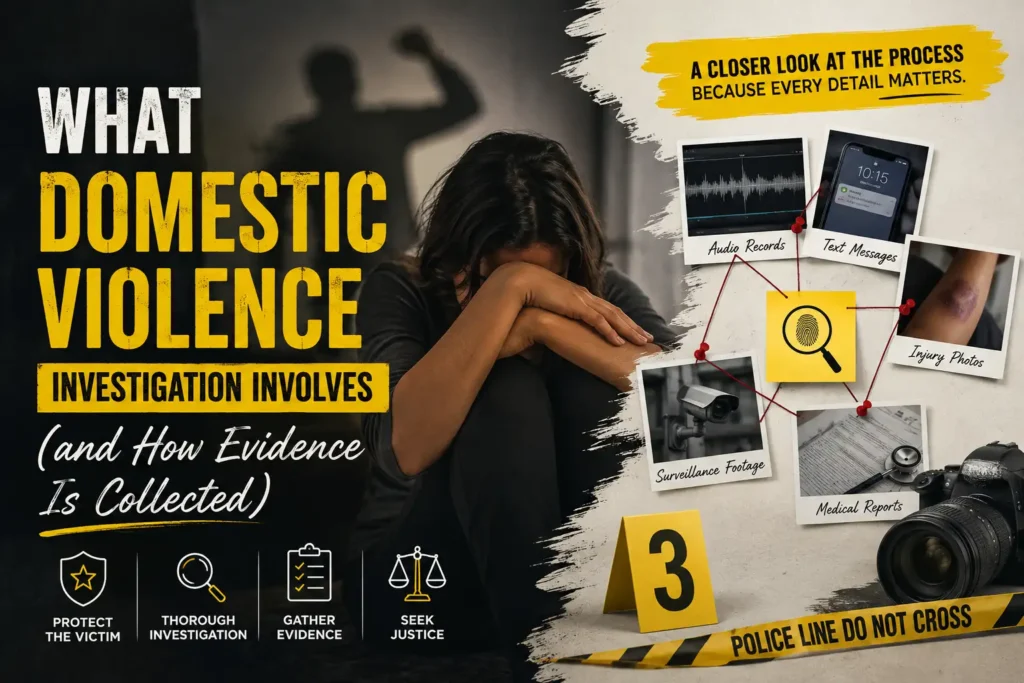
Key Insights
- Documentation beats memory. Courts and police respond better to a dated, organized record than to verbal accounts alone, since domestic violence often has no witnesses.
- Evidence goes beyond injuries. Financial records, digital messages, CCTV footage, and behaviour patterns can all count as proof, not just medical reports.
- Timing is critical. Digital evidence and CCTV footage can be lost within days, so acting early matters more than people realize.
- Safety comes first in the process. A proper investigation plans around the victim’s safety from the very first consultation, not as an afterthought.
- Professional help strengthens legal standing. Evidence collected the right way (with proper chain of custody and privacy compliance) is far more usable in court than evidence gathered informally.
Domestic violence rarely happens in front of witnesses. It plays out behind closed doors, often over months or years, which makes it one of the hardest things to prove in court. That’s the gap a domestic violence investigation is meant to close: turning a personal, painful situation into a documented, provable case.
If you’re reading this, you or someone you know may already be dealing with this. Here’s a plain-language look at what this kind of investigation actually involves, what kind of evidence gets collected, and how it holds up when a case reaches court.
What Is a Domestic Violence Investigation?
A domestic violence investigation is the process of gathering facts, documents, and proof related to abuse happening inside a home or relationship. This can include:
- Physical abuse
- Emotional or verbal abuse
- Financial control or exploitation
- Threats and intimidation
- Harassment from a spouse or in-laws
The goal is simple: build a factual, well-documented record of what’s happening. This record can support a police complaint, a court case under the Protection of Women from Domestic Violence Act, or a divorce and custody matter where safety is a concern.
It’s worth being clear about one thing upfront. An investigation doesn’t replace a lawyer, a counsellor, or the police. It works alongside them, giving everyone involved something solid to work with instead of relying on “he said, she said.”
Why Families Hire a Private Investigator for This
Many people assume domestic violence cases only need a police report and a medical certificate. In reality, courts often want more context: a pattern of behaviour, a timeline, and supporting proof beyond a single incident.
This is where a private investigator adds real value. A few common reasons families bring one in:
- The abuse has gone unreported for a long time. Without documentation, it becomes one person’s word against another’s.
- There’s a fear that evidence is being hidden or destroyed (deleted messages, hidden bank accounts, threats made only in private).
- The family needs proof for a custody or divorce case, not just a criminal complaint.
- There’s a language or literacy barrier that makes it hard for the victim to build their own case file.
- The abuser is influential or well-connected, and the family worries the case won’t be taken seriously without strong documentation.
A trained investigator knows what courts and police actually look for, and how to collect it without putting the victim at further risk.
Signs It Might Be Time to Consider an Investigation
Domestic violence doesn’t always look like visible injuries. Some situations where families start looking into an investigation include:
- Repeated arguments that turn physical, even occasionally
- A pattern of control over money, movement, or communication
- Threats made in front of family but never on record
- A spouse who isolates the other from friends and family
- Sudden, unexplained changes in behaviour, mood, or health
- Children showing signs of fear or distress around one parent
If even one of these feels familiar, it’s worth having a conversation with a professional about what documentation would strengthen a future case, even before deciding to take legal action.
How the Investigation Process Works
A proper investigation is methodical, not rushed. Here’s roughly how it unfolds.
1. Initial Consultation
The investigator sits down with the family to understand the situation: what’s happened so far, what proof already exists, and what the end goal is (a police complaint, a divorce filing, a custody hearing, or simply safety planning).
2. Case Planning
Based on that conversation, the investigator maps out what evidence is realistic to gather and how. This step also covers safety, since collecting evidence carelessly can put the victim in more danger. Nothing gets rushed here.
3. Evidence Collection
This is the core of the work, covered in detail below. It can take anywhere from a few days to several weeks, depending on how much documentation already exists and how cooperative the situation is.
4. Documentation and Reporting
Everything gets compiled into a clear, dated report. Courts and lawyers don’t just want raw material; they want it organised in a way that tells a coherent story.
5. Handover for Legal Action
The final report is handed to the family and their lawyer, who decide how to use it: a police complaint, a protection order application, or supporting material in an ongoing divorce or custody case.
What Evidence Gets Collected
This is usually the part families are most curious about. Here’s what a domestic violence investigation typically focuses on.
Medical Records
Hospital visits, doctor’s notes, and injury reports form some of the strongest evidence available. If there’s a history of treatment for injuries, an investigator will help track down and organise these records properly, with dates that build a timeline.
Photographs and Video
Visible injuries, damaged property, or unsafe living conditions are documented with timestamps wherever possible. A single photo means little on its own; a dated series over weeks or months tells a much stronger story.
Digital Communication
Threatening texts, WhatsApp messages, call logs, and emails are preserved carefully so they can’t later be claimed as fake or edited. This often involves working with a mobile forensics expert to recover deleted messages when needed.
Witness Statements
Neighbours, domestic staff, relatives, or friends who’ve seen or heard something relevant are approached carefully and their accounts recorded. Witnesses are often hesitant, so this step takes patience and tact.
CCTV and Surveillance Footage
If there’s footage from a housing complex, a nearby shop, or a building’s security system, it’s requested and preserved before it gets overwritten. Most systems only store footage for a limited number of days, so timing matters here.
Financial Records
In cases involving financial control or exploitation, bank statements, property documents, and transaction histories help establish a pattern of coercion or hidden assets.
Behavioural Patterns
An investigator may also document patterns over time: repeated late-night arguments, frequent police visits to the residence, or a consistent pattern of isolation from friends and family. Courts increasingly look at patterns, not just single incidents.
How This Evidence Holds Up Legally
India’s Protection of Women from Domestic Violence Act, 2005 recognises physical, emotional, verbal, sexual, and economic abuse, which is broader than most people expect. This matters because it means evidence doesn’t need to be limited to visible injuries. A documented pattern of financial control or emotional abuse can be just as relevant.
That said, evidence needs to be collected the right way to be usable. A few things a good investigation always keeps in mind:
- Chain of custody matters. Evidence has to be collected and stored in a way that shows it hasn’t been tampered with.
- Timing matters. Digital evidence, in particular, can be lost quickly if action isn’t taken fast.
- Privacy laws matter. There are limits on how surveillance and recordings can legally be obtained, and an experienced investigator knows where that line is.
This is exactly why working with a professional, rather than trying to gather everything alone, tends to produce a case file that actually stands up when it reaches a lawyer or a court.
Choosing the Right Investigator
If you’re searching for a private detective agency in Kolkata to help with a domestic violence case, a few things are worth checking before you hire anyone:
- Experience with sensitive family cases, not just corporate or matrimonial work
- A clear process for keeping the victim’s identity and safety protected
- Willingness to work alongside your lawyer, rather than operating in isolation
- Transparent reporting, so you know exactly what’s being collected and why
- No pressure tactics or exaggerated promises about guaranteed outcomes
Domestic violence cases are personal and often emotionally exhausting. The right agency should feel less like a service transaction and more like a team that genuinely understands what’s at stake for your family.
Frequently Asked Questions
Is hiring a private investigator for domestic violence cases legal in India? Yes. As long as the methods used respect privacy laws and don’t involve illegal surveillance (like tapping phones without consent), the evidence collected is legally usable.
How long does a domestic violence investigation usually take? It depends on the case. Simple documentation of existing evidence can take a few days. Building a fuller pattern of behaviour, especially with digital or financial evidence, can take a few weeks.
Can this evidence be used if the victim hasn’t filed a police complaint yet? Yes. In fact, having documentation ready before filing often makes the complaint process smoother, since the police and courts have something concrete to review from the start.
Will the investigation put the victim at more risk? A properly run investigation is designed to avoid this. Safety planning is part of the process from the first consultation, not an afterthought.
Final Thoughts
Domestic violence is difficult to talk about, and even harder to prove without the right documentation. A structured domestic violence investigation gives victims and their families something concrete to work with, whether that’s a police complaint, a protection order, or a stronger position in a divorce and custody case.
If you’re based in Kolkata and need support building a case with care, discretion, and experience, Cats Eye Detective Agency works closely with families and their lawyers to gather evidence the right way, so no one has to face this alone.