
Key Insights
- Privacy has limits in matrimonial disputes. The Supreme Court confirmed that the right to privacy, while fundamental, isn’t absolute, it can give way to a spouse’s legal right to prove adultery in a divorce case.
- Circumstantial evidence now carries real weight. Since direct proof of adultery is almost never available, courts can rely on things like hotel bookings and call records to build a case, instead of requiring an “in the act” catch.
- The Family Courts Act gives family courts extra flexibility. Section 14 lets these courts accept evidence that might otherwise be inadmissible under standard evidence law, making it easier to support genuine claims.
- This ruling only applies within an active matrimonial case. It doesn’t reopen adultery as a crime (that ended in 2018), and it can’t be used by outsiders to access someone’s private records outside a divorce proceeding.
- Preparation before filing matters. Since courts still check if a request for records is genuine and relevant, having solid groundwork – such as findings from an adultery investigation – can make a petition stronger before it even reaches the evidence-summoning stage.
A quick look at what happened
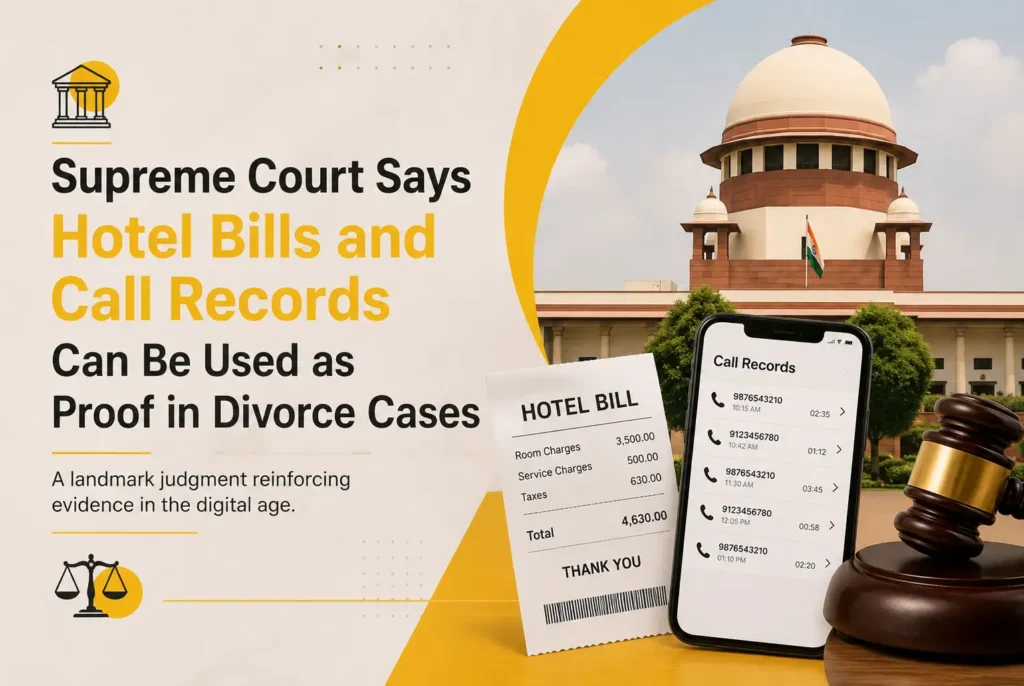
On July 2, 2026, the Supreme Court gave an important ruling for anyone dealing with a divorce case involving adultery. The Court said that asking for hotel booking records and call detail records (CDRs) to prove adultery does not break a person’s right to privacy.
This means courts can now ask hotels and telecom companies to hand over such records when one spouse accuses the other of cheating, and the case needs proof.
How did this case start?
The case began with a woman who filed for divorce. She accused her husband of cruelty and adultery. She said he stayed at a hotel in Jaipur with another woman and her daughter.
To back up her claim, she asked the family court for two things:
- The hotel’s booking and payment records for that stay
- Her husband’s call records for a set period
The husband said no. He argued that sharing this information would break his right to privacy. He also said it could affect the other woman’s reputation, and even raise questions about her daughter’s identity.
The family court sided with the wife. The husband then challenged this in the Delhi High Court. He lost there too. So he took the matter all the way to the Supreme Court.
What did the Supreme Court decide?
The Supreme Court agreed with the earlier rulings. A bench of Justice Manmohan and Justice K. Vinod Chandran dismissed the husband’s appeal.
Here’s the reasoning in simple terms:
- Privacy is a right, but not an unlimited one. The Court said privacy can be limited when there’s a strong enough reason, like helping someone prove a valid legal claim.
- Direct proof of adultery is almost impossible to get. Courts often have to depend on circumstantial evidence, like hotel stays or phone records, since catching someone “in the act” rarely happens.
- The law already allows this kind of evidence. Section 14 of the Family Courts Act lets family courts accept evidence that might not normally be allowed under standard evidence rules.
- Adultery is a valid ground for divorce under the Hindu Marriage Act. So denying access to evidence would make that legal right meaningless in practice.
What does this mean for people going through a divorce?
If you are dealing with a similar situation, here’s what this ruling means in plain terms:
- You can ask the court for help gathering evidence. If you suspect your spouse of adultery, you can request the family court to summon hotel records, call records, or similar documents.
- The other side can’t block this using privacy as a shield. Courts have made it clear that privacy claims won’t stop this kind of evidence from being collected in matrimonial cases.
- You still need to prove your case is genuine. The court will check if the request is relevant and reasonable before ordering anyone to hand over records. This isn’t a free pass to demand anyone’s personal data.
Why professional help matters before you go to court
Getting a court to summon records is only half the job. Before you even reach that stage, you need enough grounds to convince the court your request is genuine. This is where a proper adultery investigation becomes useful.
Many people going through this in West Bengal turn to a private detective agency in Kolkata to gather early, reliable proof, such as travel patterns, hotel visits, or other signs of an affair, before filing their case. Having this groundwork ready can make your court petition stronger and your request for records harder to dismiss as a fishing expedition.
A few common misunderstandings, cleared up
“Does this bring back adultery as a crime?” No. Adultery was removed as a criminal offence back in 2018. This ruling only affects adultery as a ground for divorce, which is a separate, civil matter.
“Can anyone now access someone’s call records?” No. This only applies inside an active divorce or matrimonial case. A random person cannot use this ruling to dig into someone else’s private records.
Final word
This ruling gives real support to spouses who often struggle to prove adultery due to lack of direct evidence. It confirms that courts can step in and help collect fair, relevant proof, while still keeping some checks in place so the process isn’t misused.
If you or someone you know is going through a similar legal situation, it’s a good idea to speak with a family law expert to understand how this ruling might apply to your specific case. If you’re still at the stage of gathering proof, working with an experienced team like Cats Eye Detective Agency can help you collect the right evidence the right way, so you walk into court prepared, not guessing.