
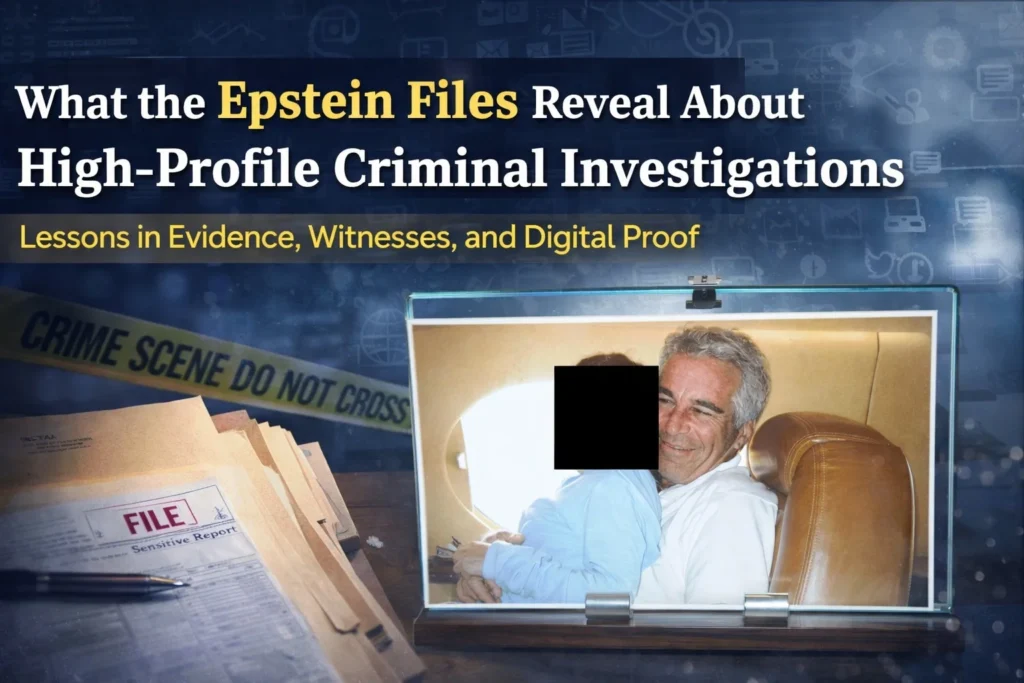
Key Insights
- High-profile criminal investigations involve greater complexity due to media attention, legal scrutiny, and international connections.
- Evidence verification and proper documentation are essential for maintaining credibility in court.
- Digital evidence now plays a major role in modern investigations, revealing communication patterns and timelines.
- Witness testimony must be supported by corroborating evidence to strengthen legal cases.
- Independent investigations help uncover overlooked details and support legal teams with objective analysis.
The release of the Epstein files has provided one of the most detailed looks into how high-profile criminal investigations unfold. These files include millions of pages of emails, travel records, witness testimonies, financial documents, and investigative reports related to the activities of financier Jeffrey Epstein and his associates.
Beyond the shocking allegations of sexual abuse and trafficking, the documents also reveal the complex investigative process behind cases involving wealthy and influential individuals. For investigators, legal professionals, and the public, the Epstein files highlight the importance of evidence collection, digital analysis, witness testimony, and transparency in major criminal investigations.
By examining the investigative methods used in this case, we can better understand how complex criminal networks are uncovered and why professional investigative processes are essential in sensitive cases.
The Scale of Evidence in the Epstein Investigation
One of the most striking aspects of the Epstein case is the sheer volume of investigative material. Authorities discovered millions of pages of records, images, and videos related to the investigation.
Investigators seized large amounts of digital evidence from Epstein’s properties, including thousands of images and extensive electronic records that helped authorities understand the scale of the alleged crimes.
Real Case Insight
According to prosecutors, thousands of photographs and digital files were recovered from Epstein’s homes in New York and the Virgin Islands. These materials formed a significant part of the evidence used during the investigation and later court proceedings.
For investigators, this highlights a key lesson:
major criminal cases often rely heavily on digital evidence collected from devices, storage systems, and online communications.
This is where structured Criminal Investigation Services become critical, as they combine digital analysis, field investigation, and evidence verification to build a reliable case.
How Travel Records Helped Investigators Map the Network
One important piece of evidence that emerged from the Epstein files was travel documentation. Investigators analyzed flight logs, travel bookings, and transportation records to identify individuals connected to Epstein.
Real Case Insight
Recently uncovered documents showed that Epstein’s team arranged international travel for young women under the pretense of modeling opportunities. Emails and travel itineraries revealed that trips were coordinated across cities such as Paris and London.
Travel records are a powerful investigative tool because they:
- Establish timelines
- Identify connections between individuals
- Reveal patterns of movement
- Link suspects to specific locations
In large criminal investigations, travel data often helps investigators reconstruct the full timeline of events.
Witness Testimonies and Victim Statements
Another critical component of the Epstein investigation was the testimony of victims and witnesses. Investigators conducted extensive interviews with individuals who reported abuse or had knowledge of Epstein’s activities.
Real Case Insight
Government files revealed that Epstein abused more than 250 underage victims across multiple locations, including New York and Florida.
Many victims provided statements describing how they were recruited or introduced to Epstein. These testimonies helped investigators identify patterns and understand how the alleged exploitation occurred.
However, witness testimony alone is not enough in court. Investigators must corroborate statements with:
- financial records
- communication logs
- travel data
- digital evidence
This layered approach strengthens the credibility of the investigation.
The Role of Powerful Networks in High-Profile Investigations
High-profile criminal investigations often involve individuals connected to business, politics, or entertainment. The Epstein files revealed that the financier maintained relationships with influential political figures, business leaders, and celebrities.
The presence of well-known individuals in documents or photos does not necessarily indicate wrongdoing, but it does complicate investigations because:
- investigators must verify each connection carefully
- public speculation can distort facts
- legal scrutiny becomes more intense
These challenges highlight why investigators must focus on verifiable evidence rather than assumptions.
Investigative Challenges Revealed by the Epstein Files
The case also exposed several challenges that private investigators face in major criminal cases.
1. Enormous Volume of Evidence
Millions of documents, emails, and photos required years of analysis.
2. Redacted or Withheld Information
Some files released to the public contained redactions to protect victims or ongoing investigations.
3. Public Pressure
High-profile cases attract intense media attention and public debate.
4. Cross-Border Investigations
Evidence often spans multiple countries and legal jurisdictions.
For investigators, these challenges require patience, careful documentation, and strict legal compliance.
Why Independent Investigations Matter
Another lesson from the Epstein files is the importance of independent verification of evidence.
Independent investigators can assist legal teams by:
- analyzing digital records
- verifying witness claims
- tracking financial transactions
- uncovering hidden connections
In complex cases, professional Criminal Investigation Services provide structured investigative support that complements law enforcement investigations.
Lessons for Modern Investigation Agencies
The Epstein investigation highlights several important lessons for modern investigators.
1. Digital Evidence Is Critical
Most modern criminal cases involve electronic communication and online records.
2. Evidence Must Be Multi-Source
Investigators must confirm claims through multiple independent sources.
3. Documentation Is Essential
Every step of the investigation must be recorded carefully.
4. Victim Protection Is Important
Sensitive cases require strict confidentiality.
5. Transparency Builds Public Trust
Public confidence increases when investigative processes are clear and accountable.
Conclusion
The Epstein files provide an important glimpse into how complex and sensitive high-profile criminal investigations are conducted. From analyzing digital evidence and travel records to verifying witness testimonies and documenting financial transactions, the case demonstrates how multiple layers of evidence are required to uncover the truth. It also highlights the challenges investigators face when cases involve influential networks, international connections, and intense public scrutiny.
Ultimately, cases like this reinforce the importance of professional investigative methods, ethical practices, and careful documentation in building credible legal cases. As investigative techniques continue to evolve, structured and evidence-driven approaches remain essential in delivering justice and accountability.
For more such insightful investigation stories, case analyses, and expert perspectives, follow the Cat’s Eye blog section, where we regularly share real-world investigative insights and updates from the world of professional investigations.
Frequently Asked Questions
The Epstein files are a collection of investigative documents, emails, photos, and witness testimonies related to the criminal investigations of financier Jeffrey Epstein.
Authorities reported that Epstein abused hundreds of victims, with more than 250 victims identified during investigations.
Government transparency laws required the release of investigative documents while protecting victims’ identities.
Some documents referenced well-known figures who had contact with Epstein, though being mentioned in the files does not automatically imply wrongdoing.
Redactions are used to protect victims, ongoing investigations, and sensitive legal information.
The case highlights the importance of digital evidence, witness verification, documentation, and multi-agency cooperation in complex criminal investigations.