Key Insights
- A screenshot is not proof. Family courts in India now treat raw WhatsApp screenshots as weak evidence because they are easy to fake. A genuine chat can still be rejected if it comes in as a plain screenshot.
- The law changed in July 2024. The Bharatiya Sakshya Adhiniyam, 2023 replaced the old Indian Evidence Act, and Section 63 now governs digital proof. The old “65B certificate” people still talk about is now the stricter Section 63 certificate.
- Certification is the deciding factor. Digital evidence usually needs a Section 63 certificate, an original file from the actual device, and a hash value that proves nothing was edited. Without these, courts can refuse to even look at it.
- Forensic analysis is what makes evidence survive objections. Pulling the real file, adding a tamper-proof digital fingerprint, and keeping a clean chain of custody turns a shaky screenshot into proof that holds up when the other side challenges it.
- It protects both sides. Forensic tools do not just strengthen your evidence. They can also flag chats that were edited or staged against you, which matters a lot in contested divorce and custody cases.
.
In many family court cases, the strongest proof sits inside a phone. A WhatsApp chat, a call recording, or a saved photo can change the outcome of a divorce, custody, or maintenance case. So people take screenshots and rush to court, sure they now have solid evidence.
Here is the hard truth: a WhatsApp screenshot on its own is often not enough. Indian courts have become strict about digital proof, and a plain screenshot can be rejected even when it is completely genuine. What holds up is properly certified digital evidence, and that is where forensic investigation services make the real difference. This guide breaks down what family courts in Kolkata actually accept, and how screenshots compare to certified forensic analysis.
Quick note: this article is general information, not legal advice. For your specific case, speak with a family law advocate.
What counts as proof in a family court case?
Family courts look at many types of evidence: documents, financial records, witness statements, photos, and increasingly, digital messages. Digital proof has become common because so much of daily life now happens on phones.
Chats, texts, emails, and call logs are treated as “electronic records” under Indian law. That means they can be used as evidence. But being usable and being accepted are two different things. The court needs proof that the record is real, complete, and has not been changed.
Family courts do have some flexibility in how they receive evidence. Even so, they still expect digital proof to be authentic. A message that cannot be verified carries little weight, no matter how important it looks.
Why WhatsApp screenshots often fail as evidence
Screenshots feel like solid proof. In practice, they are one of the weakest ways to bring digital evidence to court. Here is why.
- Screenshots are easy to fake. Names can be changed, chats can be edited with simple apps, and messages can be staged. Courts know this, so they treat raw screenshots with suspicion.
- A screenshot has no proof of source. It does not clearly show which phone it came from, when, or whether the full conversation is included.
- The law requires a certificate. Under Section 63 of the Bharatiya Sakshya Adhiniyam, 2023 (the evidence law that replaced the old Indian Evidence Act in July 2024), electronic records usually need a proper certificate to be admitted. This was the old “65B certificate,” now updated and stricter.
- Courts have rejected uncertified chats. The Supreme Court, in the Arjun Panditrao Khotkar case (2020), made clear that electronic evidence without the required certificate has no real value. High Courts have thrown out WhatsApp printouts and screenshots that came without proper certification.
In short, a screenshot may catch the other side’s attention, but it can crumble the moment the opposing lawyer objects.
What certified forensic analysis actually does
This is where forensic investigation services come in. Certified forensic analysis is the process of collecting, preserving, and verifying digital evidence in a way the court can trust.
A trained forensic expert does far more than take a picture of a screen:
- Extracts data from the original device. Instead of a screenshot, they pull the actual chat file straight from the phone, which counts as stronger, primary evidence.
- Creates a digital fingerprint. They generate a hash value (a unique code, usually SHA-256) for the file. If even one character is later changed, the fingerprint no longer matches. This proves the evidence was not tampered with.
- Maintains a clear chain of custody. They record who handled the device and when, so there are no gaps the other side can attack.
- Prepares the Section 63 certificate. They provide the certificate the court needs, including the technical details that back up the file.
- Detects edited or fake messages. Forensic tools can flag chats that were altered, deleted, or staged, which protects you from false claims too.
The result is evidence that is built to survive objections, not just to look convincing.
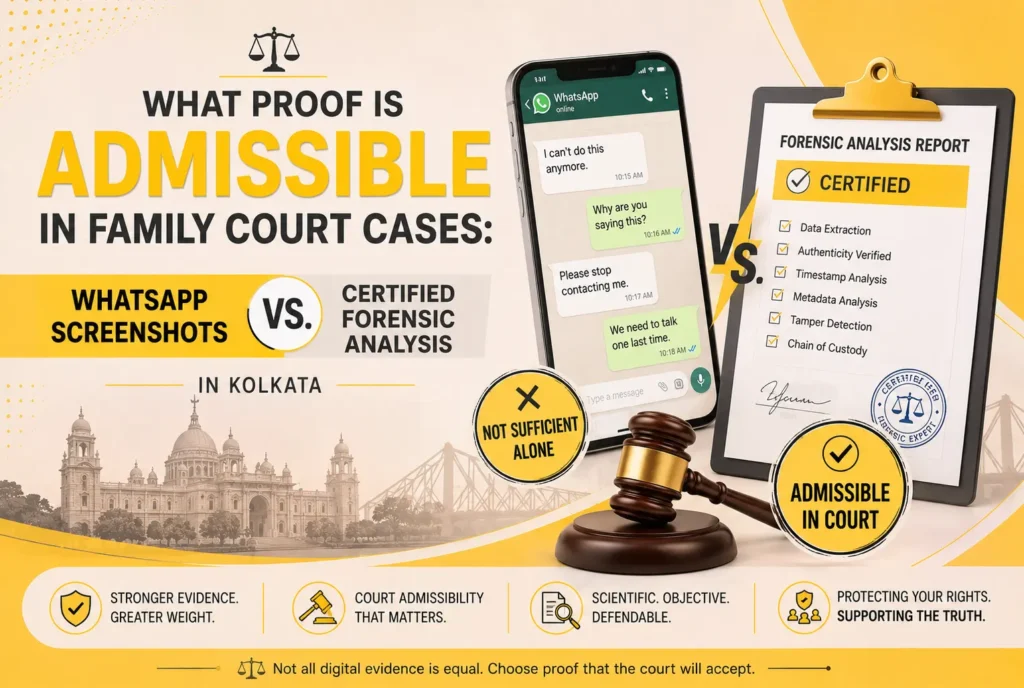
WhatsApp screenshots vs. certified forensic analysis: a simple comparison
Here is the difference side by side:
- Source proof: A screenshot shows a picture. Forensic analysis pulls the real file from the real device.
- Tamper protection: A screenshot has none. Forensic analysis uses a hash value to prove nothing was changed.
- Legal certificate: A screenshot has no certificate. Forensic analysis comes with the Section 63 certificate the court expects.
- Strength in court: A screenshot is easy to challenge. Certified forensic evidence is far harder to dismiss.
- Risk: A screenshot can be rejected outright. Forensic analysis reduces that risk sharply.
If your case depends on that chat, the choice becomes clear.
What makes digital evidence admissible in a Kolkata family court?
To give your digital proof the best chance of being accepted, it usually needs to check these boxes:
- The original source. The evidence should come from the actual device, not a random forward or a screen photo.
- A Section 63 certificate. This certificate must accompany the electronic record and confirm how it was produced and from which device.
- A verified hash value. The digital fingerprint shows the file has not been edited since it was collected.
- A clean chain of custody. A clear record of how the evidence was handled builds trust.
- Completeness. Full conversations carry more weight than a single line pulled out of context.
Meeting these points is difficult to do on your own with a phone camera. It is exactly the kind of work forensic investigation services are built for.
When should you get forensic investigation services?
Not every message needs a forensic expert. But you should seriously consider it when:
- Your divorce, custody, or maintenance case turns on digital evidence.
- You expect the other side to deny the messages or call them fake.
- The proof is critical and you cannot afford to have it rejected.
- You suspect the other party has planted or edited chats against you.
- There are recordings, deleted messages, or data spread across several devices.
When the stakes are high, treating evidence casually is a costly mistake. Getting it done right the first time can protect months of effort.
Frequently Asked Questions
Yes, but only when handled correctly. They are electronic records under the Bharatiya Sakshya Adhiniyam, 2023, and usually need a Section 63 certificate to be accepted.
You can submit it, but it is weak. A plain screenshot can be challenged or rejected because it is easy to fake and lacks proof of source.
It is a required document that proves how the electronic evidence was produced and from which device. Without it, courts can refuse to consider the record.
Forensic analysis pulls the real file from the device, adds a tamper-proof digital fingerprint, and comes with the certification courts expect. That makes it far more reliable.
Yes. Forensic investigation services strengthen your evidence, but a family law advocate presents it and argues your case in court.
Conclusion
In a family court case, the message matters, but proof of the message matters even more. A WhatsApp screenshot might feel powerful, yet it can fall apart under a single objection. Certified forensic analysis, backed by proper forensic investigation services, gives your evidence the source proof, tamper protection, and certification that courts in Kolkata expect.
If your case rests on digital evidence, do not leave it to a screenshot and hope for the best. Cats Eye Detective Agency offers professional forensic investigation services in Kolkata, helping you collect, verify, and certify digital proof so it stands strong in family court. With the right evidence handled the right way, you give your case the best possible foundation.