Key Insights
- Social media becomes the primary source of real-time information during political crises, making it both a powerful intelligence tool and a major channel for misinformation if left unchecked.
- Professional social media surveillance helps investigators distinguish facts from fake news by verifying images, videos, timelines, and account behavior using structured OSINT techniques.
- Misinformation and coordinated online campaigns can escalate unrest rapidly, which is why early detection through digital monitoring is critical for public safety and stability.
- In India, social media surveillance must operate within strict legal and ethical boundaries, including compliance with the IT Act and data protection laws, ensuring privacy is not violated.
- Trained investigators play a crucial role in protecting truth during political instability, transforming online chaos into verified intelligence that supports informed decision-making.
In today’s hyperconnected world, political crises no longer unfold only on the streets or inside government offices. They unfold online, on timelines, stories, reels, encrypted chats, and viral videos. Social media has become the first place where unrest, protests, allegations, and propaganda appear.
During political instability, the biggest challenge is not the lack of information, it is the overabundance of unverified information. False narratives spread faster than facts, and emotional content often overrides rational thinking. This is where social media surveillance plays a crucial role.
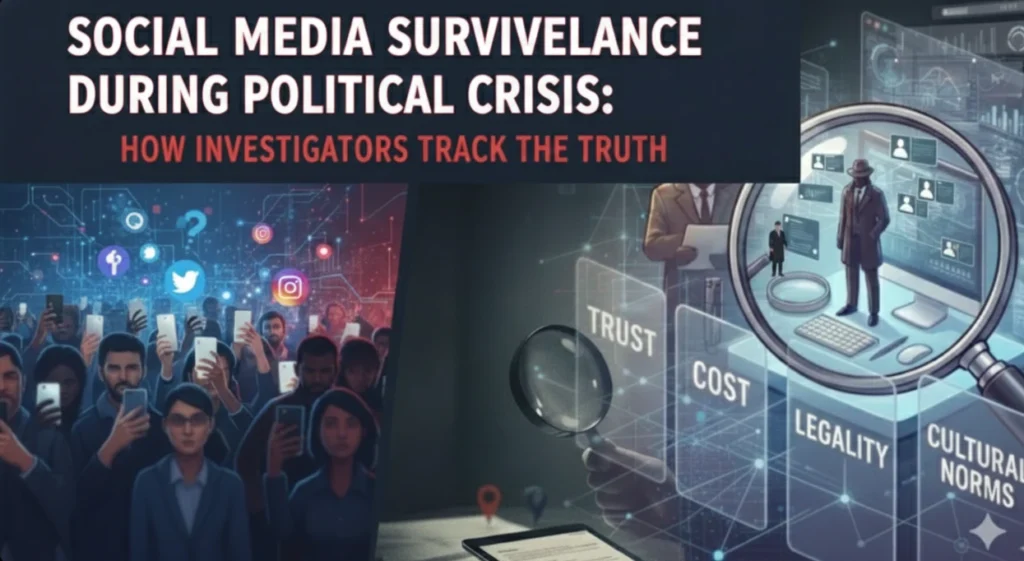
For professional investigators, social media is not just a communication platform it is a critical intelligence source. This article explores how investigators track the truth during political crises using social media surveillance, with global examples, India-focused legal context, and ethical considerations.
Why Social Media Becomes the Epicenter During Political Crises
Political crises thrive on uncertainty. People turn to social media for instant updates, eyewitness accounts, and alternative narratives when trust in traditional media weakens.
Recent global events – including the ongoing political and economic turmoil in Venezuela demonstrate how platforms like X (formerly Twitter), Facebook, Instagram, Telegram, and YouTube become real-time newsrooms. Protest calls, videos of clashes, government statements, and counterclaims often appear online before any official confirmation.
However, this immediacy comes at a cost:
- Fake videos presented as real events
- Old images recycled to create panic
- Anonymous accounts amplifying divisive narratives
- Coordinated misinformation campaigns
In such an environment, truth becomes fragile, and professional verification becomes essential.
What Is Social Media Surveillance in Political Contexts?
Social media surveillance refers to the systematic monitoring, collection, analysis, and verification of publicly available digital information shared across social platforms.
In political crises, this includes:
- Monitoring public posts, hashtags, and trends
- Tracking narratives, sentiment, and escalation patterns
- Identifying misinformation, propaganda, or coordinated campaigns
- Verifying digital evidence for legal or intelligence purposes
Unlike casual monitoring, professional surveillance follows structured methodologies, legal boundaries, and ethical standards.
How Investigators Track the Truth on Social Media
1. Identifying Misinformation and Disinformation
One of the first tasks during a political crisis is separating organic public opinion from manipulated narratives.
Investigators analyze:
- Sudden spikes in hashtags
- Multiple accounts posting identical content
- Newly created or inactive accounts pushing extreme views
- Bot-like posting behavior and abnormal engagement
This helps identify coordinated influence operations rather than genuine public sentiment.
2. Verifying Images and Videos
Visual content carries emotional power and spreads rapidly. Investigators never accept images or videos at face value.
Verification techniques include:
- Reverse image searches to detect reused or altered visuals
- Metadata analysis (when available)
- Geolocation checks using landmarks, signboards, and terrain
- Cross-referencing weather, time, and event timelines
Many viral “breaking news” videos during crises turn out to be months or years old, repurposed to fuel unrest.
3. Timeline and Context Analysis
Truth depends on context. Investigators reconstruct events by:
- Mapping post timestamps
- Comparing multiple eyewitness uploads
- Correlating online claims with offline developments
This helps determine what actually happened versus what was claimed.
4. Network and Influencer Mapping
Political narratives are often driven by a small number of influential accounts.
Investigators identify:
- Key opinion leaders
- Accounts with disproportionate reach
- Hidden links between political groups, activists, or foreign entities
This reveals who is shaping the conversation and why.
Platforms Commonly Monitored During Political Crises
Different platforms serve different purposes:
- X (Twitter): Real-time political discourse, breaking updates
- Facebook & Instagram: Mass mobilization, visual storytelling
- YouTube: Long-form narratives, speeches, and propaganda
- Telegram & WhatsApp: Encrypted coordination, closed-group messaging
Professional investigators focus strictly on publicly accessible data, avoiding illegal access or privacy violations.
India-Focused Legal Context: What Is Allowed and What Is Not
In India, social media surveillance must operate within strict legal boundaries.
Key Legal Frameworks
- Information Technology Act, 2000
Governs digital data usage, cyber monitoring, and misuse of information. - Indian Penal Code (IPC)
Covers misinformation leading to public unrest, defamation, and incitement. - Digital Personal Data Protection Act, 2023
Emphasizes lawful processing of personal data and user consent.
What Investigators Can Legally Do
- Monitor publicly available posts and profiles
- Analyze open-source data (OSINT)
- Preserve digital evidence following legal procedures
- Assist legal teams and authorities with verified intelligence
What Is Not Allowed
- Hacking private accounts
- Accessing encrypted messages illegally
- Impersonation or entrapment
- Political manipulation or bias
Professional agencies like Cats Eye operate strictly within these legal and ethical limits.
Ethical Challenges in Political Social Media Surveillance
Political investigations demand neutrality. Investigators must avoid:
- Political bias
- Selective evidence gathering
- Manipulation of findings
Ethical surveillance focuses on facts, not narratives. The goal is truth verification—not political advantage.
How Social Media Surveillance Helps Prevent Escalation
Accurate intelligence can:
- Identify early signs of violence
- Detect calls for illegal activity
- Prevent panic caused by fake news
- Support responsible decision-making
During crises, verified information can literally save lives.
Why Social Media Surveillance Matters for India
India’s scale, diversity, and digital penetration make it particularly sensitive to misinformation. Political rumors can escalate quickly across regions and languages.
Professional social media surveillance helps:
- Corporates assess political risk
- Legal teams verify digital evidence
- Individuals protect themselves from false accusations
- Institutions maintain stability during sensitive periods
The Role of Private Investigators in the Digital Age
Private investigation agencies have evolved far beyond physical surveillance.
Today’s investigators combine:
- Cyber intelligence
- OSINT methodologies
- Legal compliance
- Ground-level verification
Agencies like Cats Eye Detective Agency in Kolkata integrate digital surveillance with traditional investigation to deliver actionable, verified intelligence without crossing legal or ethical lines.
Optimizing Truth in the Age of Digital Chaos
Social media is neither good nor bad—it is powerful. During political crises, it can expose injustice or amplify lies.
The difference lies in verification.
Professional social media surveillance ensures that decisions are based on facts, not fear; evidence, not emotion.
Conclusion: Truth Is the Strongest Safeguard During Crisis
In an era where political crises unfold as much online as they do on the ground, the ability to verify information has become more important than ever. Social media surveillance, when conducted responsibly, helps separate truth from misinformation, prevents unnecessary panic, and supports informed decisions during sensitive times. Cats Eye Detective Agency in Kolkata plays a vital role in this process by combining digital intelligence expertise with strict legal and ethical standards, ensuring that facts, not rumors guide actions when clarity matters most.